


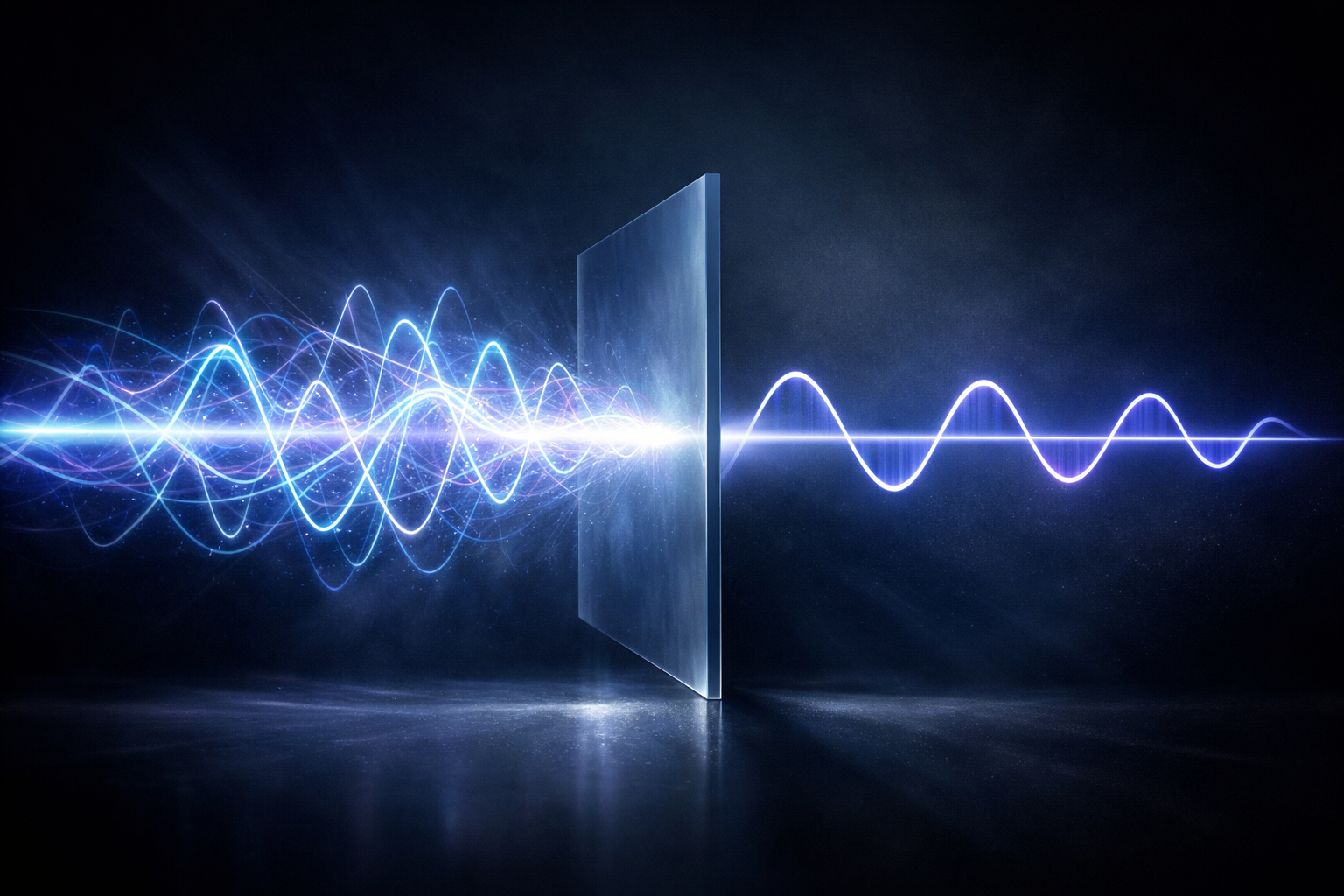
Polarization describes a special property of light. Light can be imagined as a wave, similar to a wave traveling along a rope. Sunlight, for example, oscillates disordered in many different directions. In polarized light, however, the oscillations are ordered and occur only in one specific direction.This ordered state can be created deliberately, for example by using a polarization filter.
Such filters are commonly found in sunglasses and displays. They help reduce unwanted reflections and make colors in photographs appear more vivid. Polarization also plays a central role in 3D cinema: two images with different polarizations are projected onto the screen simultaneously. Special 3D glasses ensure that each eye sees only one of these images. The brain combines them to create a three-dimensional impression.
Polarization also occurs in nature. Some animals are able to detect polarized light and use it for orientation or for recognizing members of their own species.
Beyond these everyday applications, polarization is an important building block of modern quantum technologies. In quantum cryptography, quantum communication and quantum optics, the polarization of individual particles of light—so-called photons—is deliberately used to store, transmit, and measure information. Because polarization can be controlled with high precision, it is particularly well suited as a carrier of quantum information.
Polarization thus clearly demonstrates that light has far more properties than we can perceive with the naked eye and that these properties play an essential role in the technologies of the future.