

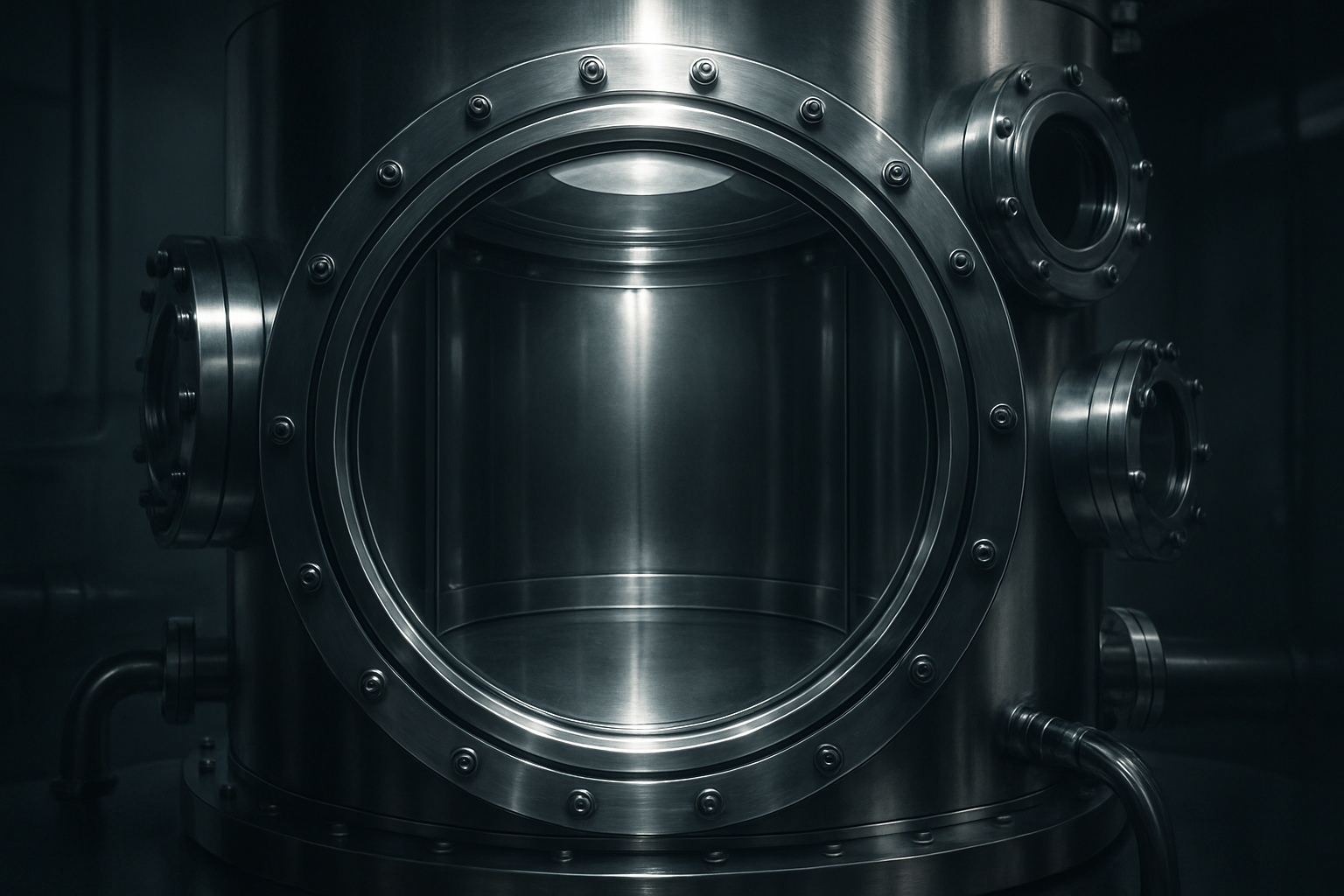
A vacuum is a space in which there is almost no matter — i.e., hardly any air, particles, or molecules. You can imagine it as an empty space in which there is nothing to feel or see.
Vacuum is used in many areas: in space research, in laboratories, in electronics, and in vacuum packaging to protect materials from air or moisture. A truly perfect vacuum hardly exists in practice, but it is possible to create very empty spaces in which physical experiments can be carried out that would not work under normal conditions.
In quantum physics, a vacuum is needed so that tiny objects can be studied undisturbed. With air or other particles, atoms, ions, or electrons would constantly collide and lose their quantum states.
Here are some examples of where vacuums are needed in modern laboratories to perform quantum physics experiments:
- Atomic traps and laser cooling: In order to trap individual atoms and slow them down to extremely low temperatures, the environment must be free of air molecules. Otherwise, the atoms would be disturbed by collisions.
- Ion traps and quantum computers: Individual ions (charged atoms) are held in traps and used as qubits. A vacuum prevents them from colliding with gas particles, which would destroy the quantum states.
- Electron and particle beam experiments: In electron microscopes or in the study of individual quantum particles, a vacuum ensures that the particles fly straight ahead unhindered, without being deflected by air molecules.
- High-precision measurements: In experiments that measure extremely fine forces, fields, or quantum states, a vacuum reduces noise and interference from the environment.